|
|
|
|---|
|
|
|
|---|


The NLV Quant is an exciting, revolutionary automotive project. Within the coming year, the NLV Quant will be fully engineered and ready for production. You can follow the last few stages. The design, drive system, range and photovoltaics of the Quant are already spectacular and record-breaking as individual components, and we believe that together they will mark a milestone in automotive history.
Technics
The NLV Quant is proof that cutting-edge supercars can combine speed, comfort and enjoyment with environmental integrity. It implents the mobile energy technology of the future. The NLV Quant has two different battery systems, a torque vectoring with 4 electric motors and a full carbon chassis. A thin-film coated photvoltaic car body supplies the operating electronics and also supports the battery. Gull-wing doors provide easy access to all four passengers.
Carbon Chassis
A reason for the car's low weight is the utilisation of a carbon-fibre monotube backbone chassis, construction, which houses the FAES system safely inside the centreline of the car at the lowest possible position, bringing down the centre of gravity and central mass point.
Using tradition lay-up, the vacuum bag generates the pressure for consolidating the carbon plies. In RTM process there are two moulds and the pressure comes only from the resin pump. The design becomes quite critical as inner and outer skin has to be perfectly defines in order to have a designed volume matching exactly the tooling volume. The risk is to have voids generated by not precise fitting of the inner cores.
Thin Film
The NLV Quant is coated with a thin film made of pyrite, which converts light into electricity to supply the operating electronics and also support the battery. This innovative pyrite technology is cost-effective, efficient and ecological.
NLV Solar AG has developed an iron-sulphur composite semiconductor using digital prototyping, with very promising results. The research indicates:
Electric Power
The NLV Quant allows for the modular installation of either a long-life metal-air battery or a rechargeable redox flow cell. These are both future-oriented, secure energy sources which help give the Quant exceptional power and range.
Speed
The projected curb weight of 1680 kg is very light considering that it is a battery-powered, four-seater, luxury performance car. This is partly due to the four-motor installation- a remarkable achievement which allows the NLV Quant to deliver 0-100 km/h in 2.8 seconds and hit a top speed of 377 km/h.
Gullwing
The gull-wing doors set the NLV Quant apart from any other four-seaters on the market. As well as being a stylish feature, they also make entry to the car more ergonomic, thanks to the lack of B-pillars. They provide easy access to both the front and rear passenger seats. The unique split side-lite feature allows either passenger to open and close the front and rear side windows separately, despite the fact that there is only one door per side.
Preliminary Specs
Features


.jpg)


The Maybach 57 and 62 were the first automobile models of the Maybach brand since the brand’s revival by DaimlerChrysler. They are derived from the Mercedes-Benz Maybach concept car presented at the 1997 Tokyo Motorshow (which was based on the Mercedes-Benz S-Class sedan). DaimlerChrysler attempted to buy the Rolls-Royce/Bentley marque when Vickers offered the company up for sale. When this att
empt failed (they were outbid by BMW and Volkswagen respectively) they introduced the Maybach as a direct challenger in 2002. Both models are variants of the same ultra-luxurious automobile. The model numbers reflect the respective lengths of the automobiles in decimetres; the 57 is more likely to
be owner-driven while the longer 62 is designed with a chauffeur in mind. The engine is a Mercedes-sourced 5.5-liter twin-turbo V12, generating 550 hp.
The Mercedes-Benz SLR McLaren is a sports car and supercar automobile co-developed by DaimlerChrysler and McLaren Cars. It is assembled at the McLaren Technology Centre in Woking, England. Most people presume “SLR” to stand for “Sportlich, Leicht, Rennsport” (German for “Sport; Light; Racing”). The car’s base price is £300,000 or $455,500. The SLR has a supercharged 5.5 (5439cc) litre dry sumped 90 degree V8. It produces 466.8 kW at 6500rpm (626 hp) and 780 N·m (575 ft·lbf)

The Porsche Carrera GT is a supercar, manufactured by Porsche of Germany. The Carrera GT is powered by an all-new 5.7 litre V10 engine producing 612 SAE horsepower (450 kW). Porsche claims it will accelerate from 0 to 100 km/h (62.5 mph) in 3.9 seconds and has a maximum speed of 330 km/h (206 mph), although road tests indicated that in actuality the car could accelerate from 0-60 in under 3.5 seconds and to 0-100 in 6.8 seconds and has a top speed of 335-340km/h.

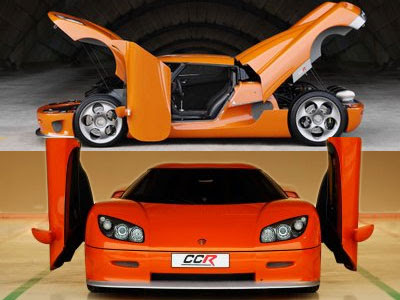
The Koenigsegg CCX is the latest supercar from Koenigsegg. CCX is an abbreviation for Competition Coupe X. The X commemorates the 10th anniversary of the completion and test drive of the first CC vehicle in 1996. The CCX is intended to be more suitable for the U.S. market and thus engineered to comply with US regulations. The CCX is powered by a Koenigsegg designed and assembled, all aluminium, 4700 cm³ DOHC 32-valve V8 based on the Ford Modular engine architecture enhanced with twin Rotrex centrifugal superchargers with response system, 1.2 bar boost pressure and an 8.2:1 compression ratio. The engine produces 806 hp (601 kW) and 678 lbf.ft (920 Nm) on 91 octane (U.S. rating) gasoline, 850 hp (634 kW) on 96 octane (Euro rating) gasoline and 900 hp (671 kW) on biofuel.

The Zonda C12 F debuted at the 2005 Geneva Motor Show. It is the most extensive reengineering of the Pagani car yet, though it shares much with its predecessors including the 7.3 L V12. Power is increased to 602 PS (443 kW/594 hp) with a special clubsport model producing 650 PS (478 kW/641 hp). The company promises a 3.2 second sprint to 60 mph (97 km/h, a top speed over 374 km/h (225 mph) and it will be the queen in braking from 300 km/h to 0 (186 mph to 0). The Zonda F clubsport has a power to weight ratio of 521 bhp/ton (384 W/kg) . Compare, for example, the Enzo Ferrari which has a power to weight ratio of 483 bhp/ton (356 W/kg).

The Enzo Ferrari, sometimes referred to as the the Ferrari Enzo and also F60 is a 12-cylinder Ferrari supercar named after the company’s founder, Enzo Ferrari. It was built in 2003 using Formula One technology, such as a carbon-fiber body, F1-style sequential shift transmission, and carbon-ceramic brake discs. Also used are technologies not allowed in F1 such as active aerodynamics. After a maximum downforce of 1709 pounds (775 kg) is reached at 186 mph (301 km/h) the rear spoiler is actuated by computer to maintain that downforce.

The Bugatti Veyron 16.4 is the most powerful, most expensive, and fastest street-legal production car in the world, with a proven top speed of over 400 km/h (407 km/h or 253 mph). It reached full production in September 2005. The car is built by Volkswagen AG subsidiary Bugatti Automobiles SAS and is sold under the legendary Bugatti marque. It is named after racing driver Pierre Veyron, who won the 24 hours of Le Mans in 1939 while racing for the original Bugatti firm. The Veyron features a W16 engine—16 cylinders in 4 banks of 4 cylinders. According to Volkswagen, the final production Veyron engine produces between 1020 and 1040 metric hp (1006 to 1026 SAE net hp), so the car will be advertised as producing “1001 horsepower” in both the US and European markets. This easily makes it the most powerful production road-car engine in history.
|
|
|
|---|